How Many Watts Does a Refrigerator Use? Refrigerator Wattage Guide
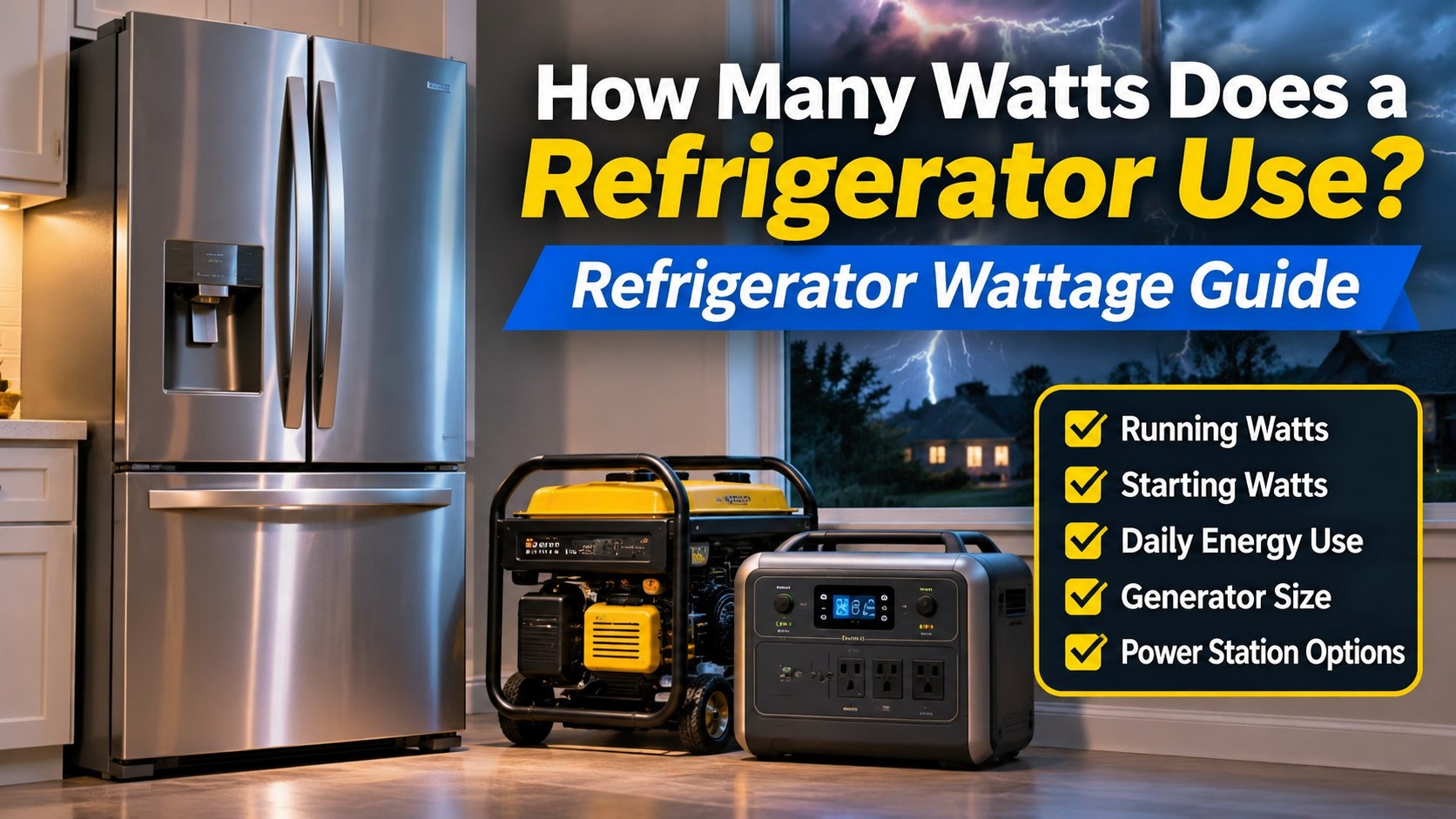
A refrigerator is one of the first appliances people think about when the power goes out. Food can spoil quickly during a long outage, so knowing your refrigerator wattage helps when choosing a portable generator, power station, or whole-home backup system.
The tricky part is that there is no single wattage number that applies to every refrigerator.
A refrigerator may use relatively little power averaged across an entire day, draw considerably more while its compressor is running, and briefly require additional power when that compressor starts. That difference is especially important when sizing backup power.
Quick Answer: How Many Watts Does a Refrigerator Use?
Many modern refrigerators use surprisingly little electricity when their total annual energy consumption is averaged across the year. ENERGY STAR listings show considerable variation based on refrigerator size, configuration, features, and efficiency.
For backup-power planning, however, you should not size a generator using annual average watts alone.
A refrigerator compressor cycles on and off throughout the day. When it starts, the appliance can briefly require considerably more power than it consumes during steady operation.
That is why generator planning usually considers two different numbers:
Running watts — the electricity the refrigerator requires while operating.
Starting or surge watts — the temporary additional power needed when the compressor starts.
In our existing Whole House Generator Size Chart, we use 700 running watts and 1,500 starting watts as a conservative planning example for a household refrigerator. That number is intentionally useful for generator sizing rather than an assertion that every modern refrigerator continuously consumes 700 watts.
Refrigerator Wattage Is Not the Same as Annual Energy Use
This distinction causes a lot of confusion.
A refrigerator’s EnergyGuide label normally expresses consumption in kilowatt-hours per year (kWh/year). Generator output, on the other hand, is normally discussed in watts.
Those measurements tell you different things.
Annual kWh tells you how much electrical energy the refrigerator is expected to consume over time. Watts tell you how much power the appliance requires at a particular moment.
For example, a refrigerator rated at 365 kWh per year would average roughly 42 watts across every hour of the year:
365,000 watt-hours ÷ 8,760 hours ≈ 42 watts average.
That does not mean the compressor only draws 42 watts while running. The refrigerator cycles. It may draw substantially more while cooling and little power between cooling cycles.
The U.S. Department of Energy evaluates refrigerator efficiency in annual kWh, and ENERGY STAR certified-product listings also publish annual energy use by model.
Typical Refrigerator Energy Use Varies by Design
Refrigerator type makes a difference.
ENERGY STAR notes that larger refrigerators generally consume more energy and that top-freezer designs tend to use less energy than comparable bottom-freezer or side-by-side refrigerators. Features such as multiple doors, automatic ice makers, through-the-door dispensers, and larger refrigerated volume can also affect consumption.
A useful way to think about refrigerator power is:
| Refrigerator Type | What to Expect |
|---|---|
| Compact or mini refrigerator | Generally lower total load, although compressor startup still matters |
| Top-freezer refrigerator | Often among the more energy-efficient full-size configurations |
| Bottom-freezer/French-door | Usually higher annual consumption than a comparable top-freezer model |
| Side-by-side refrigerator | Often uses more energy because of size and configuration |
| Older refrigerator | May consume noticeably more energy than a newer efficient model |
ENERGY STAR says refrigerators more than 15 years old can use about 20% more energy than a model that has earned the ENERGY STAR label.
Why Refrigerator Starting Watts Matter With a Generator
The compressor is the part you have to pay attention to during an outage.
Electric motors can require an additional burst of electricity when they start. That temporary surge is why a generator that appears large enough based only on running watts may still struggle when the refrigerator compressor turns on.
Imagine that your backup setup is already powering:
- several lights
- Wi-Fi equipment
- a television
- phone chargers
- a freezer
Then the refrigerator compressor starts.
Your generator has to accommodate that momentary increase without exceeding its available capacity.
This is also why our Whole House Generator Size Chart distinguishes between running and starting wattage rather than simply adding the normal operating wattage of every appliance.
How Do I Find the Wattage of My Refrigerator?
The best number is the one provided for your refrigerator, not a generic chart.
Start with the appliance information label, EnergyGuide label, owner’s manual, or manufacturer’s specification sheet.
Look for:
Watts (W): If wattage is listed directly, you already have a useful operating figure.
Volts (V) and amps (A): When both are supplied, watts can be estimated using:
Watts = Volts × Amps
Do not automatically assume that the circuit rating equals actual operating consumption. A refrigerator may be connected to a 15- or 20-amp circuit without continuously drawing anywhere near the maximum capacity of that circuit.
For generator sizing, also check whether the manufacturer publishes startup, locked-rotor, compressor, or surge information.
How Much Electricity Does a Refrigerator Use Per Day?
If you know the annual kWh figure from the EnergyGuide label, estimating daily consumption is simple.
Suppose a refrigerator is rated at 400 kWh per year.
400 kWh ÷ 365 days ≈ 1.10 kWh per day
That is approximately 1,100 watt-hours of electricity per day under the conditions represented by the appliance’s test rating.
Real-world consumption can change with room temperature, thermostat settings, door openings, how much food is inside, airflow around the appliance, and the condition of the door seals.
This daily-energy number becomes particularly useful when comparing a refrigerator with a portable power station, because power-station batteries are normally rated in watt-hours rather than gallons of fuel.
What Size Generator Do I Need to Run a Refrigerator?
You generally do not need a huge whole-house generator just to keep one refrigerator operating.
The important requirement is that the generator’s continuous output can handle the refrigerator while also leaving enough headroom for other equipment, and that its surge capacity can accommodate compressor startup.
For planning purposes, our existing home-sizing guide uses:
| Appliance | Running Watts | Starting Watts |
|---|---|---|
| Refrigerator | 700W | 1,500W |
That is deliberately a conservative household-generator planning figure.
If your actual refrigerator specification shows a lower requirement, use the manufacturer’s numbers when selecting equipment.
A 2,000-watt generator may therefore be enough for many refrigerator-only situations, but that does not mean every 2,000-watt generator is automatically suitable. You must also account for whatever else will be connected at the same time.
Can a 2,000-Watt Generator Run a Refrigerator?
In many cases, yes.
A 2,000-watt generator can often operate a household refrigerator provided its continuous and surge ratings meet the refrigerator’s actual requirements and the generator is not simultaneously carrying too many additional loads.
This is where starting watts become important.
If the refrigerator briefly requires around 1,500 watts during startup and your generator is already supplying 800 watts to other appliances, the combined demand could exceed what a small generator can provide.
The safer approach is to total the loads you expect to use together rather than sizing the generator around the refrigerator alone.
Can a Portable Power Station Run a Refrigerator?
Yes, some portable power stations can run refrigerators, but there are two different specifications to check.
The first is AC output wattage. The inverter must be capable of handling the refrigerator’s operating load and compressor surge.
The second is battery capacity in watt-hours (Wh). Battery capacity determines approximately how long the refrigerator can operate before the power station needs recharging.
A 1,000Wh power station, for example, does not mean it will deliver exactly 1,000Wh to the refrigerator. Inverter losses, battery management, temperature, and the refrigerator’s cycling behavior all affect actual runtime.
We already have a Power Station With Solar Panels Calculator that estimates runtime, recommended battery size, and solar recharge time for common devices, including a mini refrigerator.
That tool is a better place to experiment with different battery and solar-panel sizes than trying to force one universal runtime number into this article.
How Long Will a Power Station Run a Refrigerator?
Runtime depends primarily on usable battery capacity and the refrigerator’s real energy consumption.
A simplified estimate is:
Usable battery watt-hours ÷ average refrigerator watts = estimated hours
But real refrigerators cycle, and portable power stations lose some energy through the inverter and electronics.
For that reason, runtime calculations should be treated as estimates rather than guarantees.
A refrigerator that averages relatively little power over 24 hours may run much longer from a battery than its compressor wattage alone suggests. On the other hand, hot weather, frequent door openings, older equipment, or poor insulation can increase consumption.
Use our Power Station With Solar Panels Calculator when you want to test battery capacity, selected loads, solar wattage, and estimated recharge time together.
Can a Generator Run a Refrigerator and Freezer at the Same Time?
Usually, yes—if the generator has enough continuous and surge capacity for both appliances.
The main concern is what happens if both compressors start at approximately the same time.
Add the normal operating loads, then make sure the generator has enough additional capacity to handle the largest realistic startup surge.
If you are also operating a sump pump, well pump, microwave, air conditioner, or another motor-driven appliance, those startup loads need to be considered too.
For larger home-backup systems, our 17,000-Watt Generator Guide shows how refrigeration, HVAC, pumps, kitchen appliances, and other household loads can be combined when estimating generator capacity.
Will a Refrigerator Use the Same Wattage All Day?
No.
A refrigerator is not normally drawing its full cooling load 24 hours a day.
The compressor cycles on when the refrigerator needs cooling and turns off once the thermostat reaches the target temperature. Defrost cycles, fans, ice makers, control electronics, lighting, and door openings can also change instantaneous power consumption.
This is why three refrigerator numbers can all be correct at the same time:
Annual energy use: how much electricity it consumes over a year.
Running wattage: how much power it uses during active operation.
Starting wattage: the brief surge required to start the compressor.
For backup-power sizing, you need to understand all three.
Older Refrigerators Can Change the Calculation
An older refrigerator deserves special attention before choosing a generator or battery backup.
Worn door seals, aging compressors, poor condenser airflow, inefficient insulation, and older appliance designs can increase electricity use.
ENERGY STAR specifically notes that an old refrigerator can use around 20% more energy than an ENERGY STAR model.
That means a wattage estimate taken from a modern refrigerator should not automatically be applied to a 20-year-old garage refrigerator or freezer.
When possible, use the actual model’s specifications or measure its electricity consumption with an appropriate plug-in energy meter.
Refrigerator Backup Power During an Outage
If your only concern is preserving food, you may not need to power every circuit in the house.
A smaller generator or adequately sized power station may be enough for:
- refrigerator
- freezer
- a few LED lights
- Wi-Fi
- phones
- small electronics
That can dramatically reduce the backup capacity required compared with powering central air conditioning, electric water heating, electric ranges, dryers, and other high-demand equipment.
If you want to run much more than refrigeration and a few essentials, use our Whole House Generator Size Chart to estimate larger home loads.
Gas Generator or Power Station for a Refrigerator?
Both can work, but they solve the problem differently.
A portable generator can continue producing power as long as fuel is available. That makes it attractive for long outages, especially when several household appliances must operate.
A portable power station is quiet, produces no engine exhaust during operation, and can be used indoors according to the manufacturer’s instructions. Its limitation is stored battery capacity; once the battery is depleted, it must be recharged.
For short outages or nighttime use, a power station can be convenient. For multi-day outages, a fuel-powered generator may offer greater endurance.
Some households use both.
Do Not Run a Fuel-Burning Generator Indoors
A portable gasoline, propane, or natural-gas generator must never be operated inside a house, garage, basement, shed, or other enclosed area.
Carbon monoxide can accumulate quickly and can be deadly.
Always follow the generator manufacturer’s placement instructions and current safety recommendations regarding exhaust direction and distance from occupied structures.
Battery power stations do not have combustion-engine exhaust, but they still need to be operated, charged, stored, and connected according to the manufacturer’s instructions.
The Bottom Line
There is no single refrigerator wattage that applies to every home.
Modern refrigerator energy use varies substantially by model, size, configuration, age, temperature, and operating conditions. And the wattage needed while the compressor is running is different from the refrigerator’s average electricity consumption across an entire day.
For generator planning, the most important numbers are the refrigerator’s running watts and starting surge.
For battery planning, you also need to know daily energy consumption in watt-hours or kilowatt-hours.
Our existing generator-sizing guide uses 700 running watts and 1,500 starting watts as a conservative refrigerator planning example, but your refrigerator’s own specifications should always take priority.
Once you know the appliance load, you can decide whether a smaller portable generator, a battery power station, or a larger home-backup system makes the most sense.
Frequently Asked Questions
How many watts does an average refrigerator use?
There is no single average that accurately describes every refrigerator because compressors cycle on and off and annual energy use varies widely by design. ENERGY STAR publishes model-specific annual consumption in kWh/year, while generator planning requires the appliance’s operating and startup requirements.
How many watts does a refrigerator need to start?
Starting wattage depends on the refrigerator and compressor. The startup requirement can be significantly higher than normal operating demand. For conservative generator planning, our existing sizing guide uses 1,500 starting watts for a household refrigerator example.
Will a 1,000-watt generator run a refrigerator?
Possibly, but do not assume that it will. Check the refrigerator’s running and starting requirements against the generator’s continuous and surge ratings. A larger generator provides more room for startup loads and additional devices.
Will a 2,000-watt generator run a refrigerator?
Many refrigerators can be operated by a 2,000-watt generator, provided the generator has sufficient startup capacity and other connected loads do not push total demand beyond its limits.
How many watts does a mini fridge use?
Mini refrigerators generally have lower energy requirements than full-size refrigerators, but wattage varies by model. Our power-station calculator currently uses 90 watts average as a general mini-fridge estimating value rather than a specification for every model.
How much electricity does a refrigerator use per year?
It varies substantially by model. The refrigerator’s EnergyGuide label and the ENERGY STAR product database provide annual consumption in kWh/year. Refrigerator type, volume, door configuration, ice-making features, and efficiency all influence the result.
Is a power station better than a generator for a refrigerator?
Neither is automatically better. A power station is quiet and does not produce combustion exhaust, while a fuel-powered generator can provide power for much longer when additional fuel is available. The better choice depends on outage duration, refrigerator load, other appliances, battery capacity, fuel availability, and where the equipment will be operated.