Quietest Portable Generators for Home Use
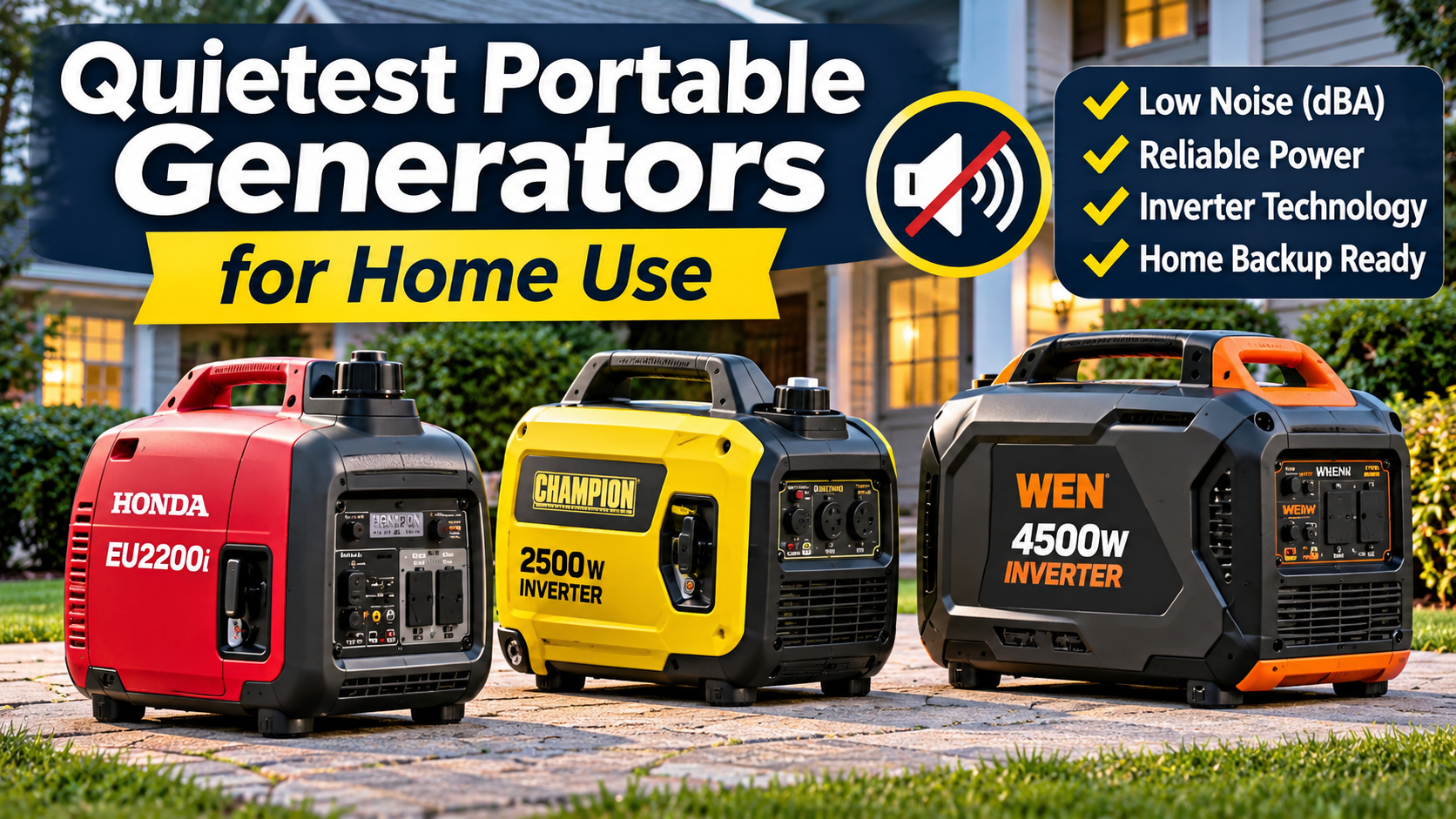
A portable generator can be extremely useful during a power outage, but traditional generators can also be loud enough to become irritating to you, your family, and your neighbors.
That is one reason inverter generators have become so popular for home backup. Instead of running an engine at full speed all the time, many inverter generators can adjust engine speed as electrical demand changes. The result can be lower fuel consumption and noticeably quieter operation when the generator is carrying a lighter load.
If noise is one of your priorities, however, do not shop by words such as “super quiet” or “silent” alone. Look for a published dBA rating, the distance at which it was measured, the load used during testing, and whether the generator has an enclosed inverter design.
Quick Comparison: Quiet Portable Generators
The generators below represent several different power levels, from small units suitable for essential loads to larger models capable of supporting more equipment during an outage.
| Generator | Starting Watts | Running Watts | Published Noise Level | Best For |
|---|---|---|---|---|
| Honda EU2200i | 2,200W | 1,800W | 48–57 dBA | Premium small backup |
| Champion 2500W Dual Fuel Inverter | 2,500W | 1,850W gas | 53 dBA | Lightweight dual-fuel use |
| AIVOLT 1600W Inverter | 1,600W | 1,260W | 57 dBA | Small essential loads |
| WEN DF452iX Dual Fuel Inverter | 4,500W | 3,500W gas | 58 dBA | Mid-size home backup |
| Aceup Energy 4000W Dual Fuel | 4,000W | 3,200W gas | About 60 dBA | Budget dual-fuel backup |
The published numbers should not be treated as perfectly controlled head-to-head laboratory results. Test distance and generator load can differ between manufacturers.
That matters because a generator measured at 25% load will normally sound quieter than the same generator operating near its maximum output.
What Is Considered a Quiet Portable Generator?
Sound is usually expressed in decibels, or dB. Generator manufacturers commonly publish an A-weighted measurement written as dBA, which is intended to approximate how the human ear perceives sound.
For perspective, Honda’s generator comparison material places normal speech around the 50 dBA area and a vacuum cleaner around 60 dBA. Its inverter generator lineup includes models with published ratings ranging from the upper 40s into the upper 50s depending on model and load.
That makes a portable inverter generator operating somewhere in the 50-to-60 dBA range at light load meaningfully quieter than many conventional open-frame generators.
But there is another detail worth understanding.
Decibels use a logarithmic scale. A relatively small numerical increase can represent a meaningful change in sound energy, so the difference between 53 dBA and 63 dBA should not be dismissed simply because the numbers appear close.
Honda EU2200i — Excellent Choice When Quiet Operation Comes First
The Honda EU2200i remains one of the strongest reference points when discussing quiet portable inverter generators.
Honda lists the EU2200i at 48 dBA at one-quarter load and 57 dBA at rated load. It produces 2,200 maximum watts and 1,800 rated watts and weighs approximately 47.4 pounds. Honda also lists a runtime of up to 8.1 hours at one-quarter load from its 0.95-gallon fuel tank.
The EU2200i is not designed to power an entire house. Instead, it makes more sense when the goal is running a refrigerator, lights, electronics, fans, chargers, or a limited collection of essential loads.
Why we like it
Its biggest advantage is not simply a low published noise number. Honda publishes noise figures at both light and rated load, which gives shoppers a much clearer idea of how noise can change as demand increases.
Honda also specifically lists refrigerators and freezers among the applications the EU2200i can support, although not every listed appliance can necessarily be operated simultaneously.
For homeowners who value low noise and proven inverter technology more than maximum wattage, it remains a compelling benchmark.
Champion 2500W Dual Fuel Inverter — Best Lightweight Dual-Fuel Option
Champion’s 2,500-watt dual-fuel inverter is an especially interesting choice for homeowners who want quiet operation without giving up propane capability.
Champion rates the model at 53 dBA from 23 feet. On gasoline, it produces 2,500 starting watts and 1,850 running watts. Champion says it can run for up to 11.5 hours on gasoline and considerably longer when connected to a 20-pound propane tank under the manufacturer’s stated conditions.
The generator also includes Champion’s CO Shield carbon-monoxide shutoff system and is parallel capable.
Why we like it
Dual fuel adds flexibility during an outage.
Gasoline may be convenient when service stations are operating normally, while propane can be easier to store for longer periods. Being able to use either fuel gives a homeowner another option when one fuel is difficult to obtain.
At around the mid-40-pound range, this model is also substantially easier to move than many larger home-backup generators.
For someone who primarily wants to keep refrigeration, lights, communications equipment, and several smaller devices operating, this is one of the more practical quiet-generator configurations.
WEN DF452iX — Better for Homeowners Who Need More Power
Moving from a 2,000-to-2,500-watt inverter into the 4,000-watt class changes what you can realistically support.
The WEN DF452iX produces up to 4,500 surge watts and 3,500 rated watts on gasoline, while propane operation provides somewhat less continuous output.
WEN publishes a noise level of 58 dBA at quarter load from 22 feet. It is also dual fuel, includes remote electric start, and uses an enclosed inverter design.
Why we like it
The additional wattage gives homeowners significantly more flexibility.
Instead of planning around only a refrigerator and a few electronics, a generator in this range can potentially accommodate a broader essential-load plan.
That does not mean it can automatically power everything in a house. Central air conditioning, electric water heaters, electric dryers, well pumps, and other high-demand equipment can change the calculation dramatically.
If you are unsure how much generator capacity your home actually needs, use our Whole House Generator Size Chart before choosing a model.
Aceup Energy 4000W Dual Fuel — Quiet Mid-Range Alternative
The Aceup Energy 4,000-watt dual-fuel inverter is another example of how modern inverter designs can combine useful home-backup capacity with relatively restrained noise.
The manufacturer information associated with this model lists approximately 60 dBA in Eco mode at 23 feet with a 25% load. It produces 4,000 peak watts and 3,200 rated watts on gasoline, with slightly lower output when operating on propane.
That output level places it in an interesting middle ground.
It offers much more capacity than the smallest recreational inverters without moving into the very large, heavy portable-generator category.
Who it makes sense for
A generator like this can make sense for a homeowner who wants:
- refrigeration
- lighting
- internet equipment
- television
- chargers
- several additional essential loads
without buying a very large open-frame unit.
The exact combination depends on starting and running wattage, so appliance loads still need to be calculated before connecting them.
AIVOLT 1600W — Small and Lightweight for Essential Loads
Not everyone needs 4,000 or 5,000 watts.
The AIVOLT 1600W inverter generator is aimed at people who prioritize portability and relatively light electrical loads.
Its published specifications list 1,600 starting watts and 1,260 running watts, with a noise rating of approximately 57 dBA at 23 feet.
At this power level, careful load management becomes especially important.
A refrigerator compressor starting while other appliances are operating can consume a substantial percentage of the generator’s available capacity.
This is therefore better viewed as an essential-load generator rather than a general whole-home backup unit.
Why Inverter Generators Are Usually Quieter
The design of an inverter generator helps explain why so many of the quieter portable models fall into this category.
A conventional portable generator may operate its engine at a relatively constant high speed to maintain electrical frequency.
An inverter generator can generate electricity differently and electronically condition the output. Many designs can reduce engine speed when electrical demand falls.
Lower engine speed can mean:
- less noise
- lower fuel consumption
- less vibration
- longer runtime under lighter loads
Enclosed inverter generators can further reduce perceived noise because the housing helps contain engine and mechanical sound.
This is why a smaller enclosed inverter generator can sound dramatically different from a large open-frame construction-style generator.
Quiet Does Not Mean Silent
There is effectively no gasoline or propane portable generator that becomes silent while its engine is running.
Terms such as silent generator, ultra quiet, and super quiet are marketing descriptions rather than universal acoustic standards.
A 53 dBA inverter generator still produces audible engine noise.
What changes is how intrusive that sound feels compared with a traditional open-frame generator.
This distinction becomes especially important during extended outages. A generator that sounds acceptable for ten minutes can become much more noticeable after running outside the home for ten hours.
Generator Noise Usually Increases With Load
A generator’s advertised noise rating may represent a light-load condition.
That is why two generators cannot always be fairly ranked by taking the dBA number from each product page and placing them side by side.
Honda, for example, publishes the EU2200i at both 48 dBA at quarter load and 57 dBA at rated load. That nine-decibel spread demonstrates how much operating conditions can affect the published result.
When comparing generators, look for:
Testing distance. A generator measured farther away will produce a lower reading at the measurement point.
Electrical load. Quarter-load testing tends to produce quieter results than rated-load operation.
Eco mode. Some ratings are achieved while an economy mode is reducing engine speed.
Enclosure. Fully enclosed inverter generators generally control sound better than open-frame designs.
Those details matter more than simply choosing whichever product page shows the smallest number.
What Size Quiet Generator Do You Need for Home Backup?
Noise should come after capacity.
A beautifully quiet generator that cannot start your refrigerator, sump pump, or other essential appliance is still the wrong generator.
Start by determining what you want to keep operating during an outage.
A small home-backup list might include a refrigerator, freezer, LED lighting, Wi-Fi equipment, television, phones, and several outlets.
A larger plan might add a furnace blower, sump pump, well pump, microwave, window air conditioner, or other equipment.
Each additional motor-driven appliance can introduce startup wattage that must be considered.
Our Whole House Generator Size Chart explains running watts, starting watts, and approximate household-generator capacity in more detail.
Can a Quiet Generator Run a Refrigerator?
Yes. Many inverter generators can run a refrigerator if their continuous and surge ratings are sufficient.
Refrigerators deserve special attention because the compressor requires additional power when starting.
For generator planning, we use 700 running watts and 1,500 starting watts as a conservative household-refrigerator example in our whole-house sizing guide. Your refrigerator’s actual specifications should take priority.
A small 2,000-to-2,500-watt inverter can therefore be enough for many refrigerator-plus-essential-load situations, provided the total connected demand remains within the generator’s limits.
For a deeper breakdown, see our Refrigerator Wattage Guide.
Quiet Generator vs. Portable Power Station
If noise is the absolute priority, a battery power station has an important advantage: there is no combustion engine running.
That makes power stations especially appealing for:
- overnight refrigerator backup
- CPAP equipment
- phones and laptops
- Wi-Fi
- lighting
- indoor emergency power
Their limitation is battery capacity.
A fuel-powered generator can continue running as long as suitable fuel is available. A power station eventually needs to be recharged.
This makes a hybrid strategy attractive for some households: use a generator during part of the day to handle larger loads and recharge batteries, then switch to a power station when extremely quiet operation is desirable.
Our Power Station With Solar Panels Calculator can help estimate battery capacity, runtime, and solar recharge requirements.
How to Make a Portable Generator Seem Quieter
Generator placement can have a major effect on perceived noise, but safety must come first.
Never move a generator closer to a building, place it inside a garage, or construct an unsafe enclosure just to reduce sound.
Exhaust must be directed away from occupied buildings, and the generator must be operated according to the manufacturer’s carbon-monoxide and clearance instructions.
Within those safety limits, several practical factors can influence perceived sound.
Greater distance generally reduces the noise reaching you or your neighbors. Solid outdoor structures can sometimes change how sound travels, and simply pointing the generator’s loudest side away from living areas may help.
Never block cooling airflow or exhaust in an attempt to suppress noise.
Are Quiet Generators Worth Paying More For?
For many homeowners, yes.
Noise tends to matter most when a generator is used for extended periods rather than for a short emergency task.
During a multi-day outage, a quieter generator can make it easier to:
- sleep
- talk outdoors
- use patios or yards
- avoid disturbing nearby homes
- run backup power overnight when permitted and safe
An inverter generator can also offer additional advantages, including variable engine speed and cleaner electrical output for sensitive electronics.
The tradeoff is that quiet inverter models can cost more per watt than basic open-frame generators.
Best Quiet Generator for Home Use: What We Would Choose
There is no single winner for every homeowner.
For a small premium generator where quiet operation matters most, the Honda EU2200i is difficult to ignore. Its published 48-to-57 dBA range gives unusually useful information about both light-load and full-load behavior.
For dual-fuel flexibility in a lightweight package, the Champion 2500W Dual Fuel Inverter is particularly attractive at its published 53 dBA rating.
For more substantial home-backup capacity, the WEN DF452iX moves into the 4,500-watt class while maintaining a published 58 dBA quarter-load rating.
The best choice is ultimately the quietest generator that can still safely supply the loads you actually need.
Generator Safety Still Comes First
Noise is never a reason to place a generator too close to a home.
Portable fuel-burning generators produce carbon monoxide, an odorless and potentially deadly gas.
Never run a gasoline, propane, or natural-gas portable generator inside a house, basement, garage, shed, or other enclosed or partially enclosed space.
Follow the generator manufacturer’s placement, ventilation, grounding, connection, and carbon-monoxide instructions exactly.
A quieter generator can make an outage much more comfortable, but safe placement is always more important than sound reduction.
Final Thoughts
The quietest portable generators for home use are usually enclosed inverter generators, particularly when they operate at lighter loads.
But noise level should never be evaluated by itself.
A homeowner should compare:
published dBA level, measurement distance, load during testing, running watts, starting watts, fuel type, runtime, weight, and intended use.
A 2,000-watt inverter may be ideal for refrigeration and a few essentials. A 4,000-to-5,000-watt inverter gives you considerably more flexibility. Larger systems may be necessary if your goal is to support major household equipment.
The real objective is not to find the lowest dBA number on a product page.
It is to find a generator that is quiet enough to live with and powerful enough to do the job.
Frequently Asked Questions
What is the quietest type of portable generator?
Enclosed inverter generators are generally among the quietest fuel-powered portable generators because their engines can vary speed with load and their housings help contain mechanical noise.
Is 50 dBA quiet for a generator?
Yes. A generator operating around 50 dBA under the manufacturer’s stated test conditions would be considered very quiet for a combustion-engine portable generator. Honda lists some of its small inverter generators in the upper-40-to-50-dBA range at lighter loads.
Is 60 dBA loud for a generator?
Around 60 dBA is still relatively quiet compared with many conventional open-frame generators, particularly when measured from typical manufacturer testing distances. Perceived loudness depends heavily on distance, surroundings, generator load, and where the listener is positioned.
Are inverter generators quieter than regular generators?
They frequently are. Variable engine speed and enclosed housings are two major reasons many inverter generators produce less noise than conventional open-frame designs, especially under light loads.
Can a quiet 2,000-watt generator run a refrigerator?
Often, yes, provided the refrigerator’s starting surge and running wattage fit within the generator’s continuous and surge capacity. Other connected appliances must also be included in the calculation.
What is a good noise level for a home generator?
For a portable generator being chosen specifically for reduced noise, published ratings in roughly the 50-to-low-60-dBA range at lighter loads are worth considering. Always compare the manufacturer’s testing distance and load before assuming one generator is quieter than another.
Are propane generators quieter than gasoline generators?
Fuel alone does not determine generator noise. Engine design, RPM, enclosure, inverter technology, load, exhaust system, and overall construction all influence sound. A dual-fuel generator may sound somewhat different between fuels, but propane does not automatically make every generator quiet.
Can I build a box around my generator to make it quieter?
Do not place a generator inside an improvised enclosure that can restrict cooling or allow carbon monoxide to accumulate. Any sound-reduction setup must maintain the clearances, ventilation, exhaust routing, and operating conditions required by the generator manufacturer.