Best Portable Generators for Home Backup Power
A portable generator can keep the most important parts of a home running when the utility power goes out, but choosing the right one takes more than simply buying the model with the highest wattage.
For home backup, the best portable generators combine enough starting and running power for essential appliances with practical fuel options, a useful 120/240-volt output, safe connection options, and enough runtime to get through an extended outage.
For many homeowners, that means looking at generators in roughly the 5,000- to 13,000-watt range rather than the small recreational models commonly used for camping.
In this guide, we compare several strong home-backup choices and explain which type of homeowner each one suits best.
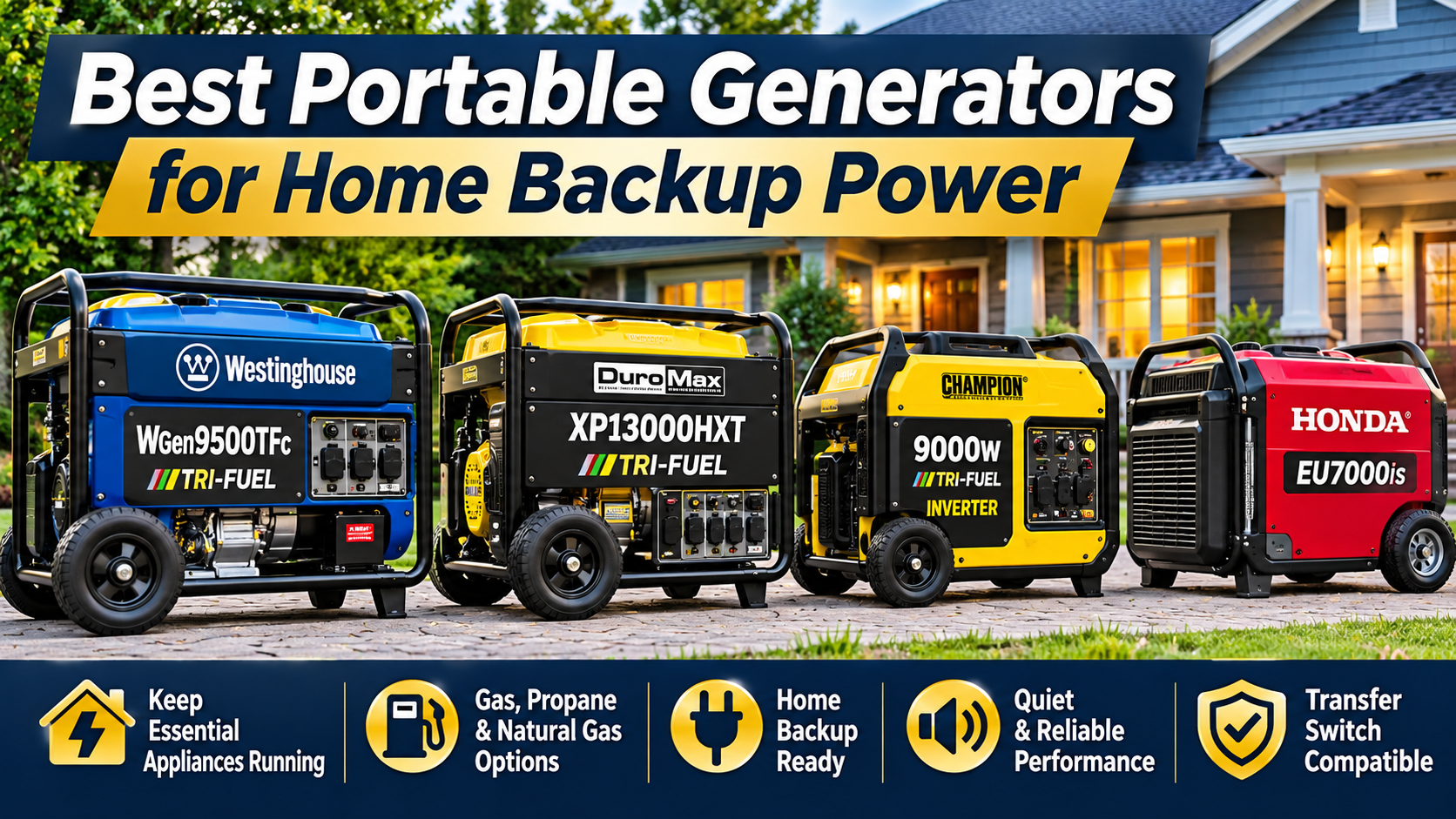
Quick Picks: Best Portable Generators for Home Backup
| Generator | Gas Running Watts | Peak Watts | Fuel Options | Best For |
|---|---|---|---|---|
| Westinghouse WGen9500TFc | 9,500W | 12,500W | Gas, propane, natural gas | Best overall home backup |
| DuroMax XP13000HXT | 10,500W | 13,000W | Gas, propane, natural gas | Larger essential-load setups |
| Champion 9000W Tri-Fuel Inverter | 7,250W | 9,000W | Gas, propane, natural gas | Cleaner inverter power and fuel flexibility |
| Honda EU7000iS | 5,500W | 7,000W | Gasoline | Quiet premium inverter backup |
These are not interchangeable. A homeowner who wants to operate a refrigerator, furnace blower, sump pump, and lights has very different requirements from someone who also wants to operate a well pump, microwave, window air conditioner, or other larger loads.
Before choosing a generator, see our Whole House Generator Size Chart to understand running watts, starting watts, and how household loads add together.
Best Overall: Westinghouse WGen9500TFc
The Westinghouse WGen9500TFc is one of the strongest combinations of output, fuel flexibility, and home-backup features in the portable-generator category.
On gasoline, it produces 9,500 running watts and 12,500 peak watts. Output decreases somewhat on propane and natural gas, but having all three fuel options can be extremely useful during an extended outage.
Westinghouse lists:
- 9,500 running / 12,500 peak watts on gasoline
- 8,500 running / 11,200 peak watts on propane
- 7,500 running / 9,500 peak watts on natural gas
- 120/240-volt output
- L14-30R and 14-50R connections
- transfer-switch-ready configuration
- remote, electric, and recoil starting
- carbon-monoxide sensor
- up to 15 hours of gasoline runtime at 25% load
That combination makes the WGen9500TFc particularly attractive for homeowners who want to operate several important household loads rather than one or two individual appliances.
Why We Like It
The biggest advantage is flexibility.
Gasoline provides the highest output, propane is convenient to store, and natural gas can be useful for homes that already have an available gas supply and an appropriate connection.
The 50-amp 120/240-volt outlet is also much more useful for home backup than the basic household receptacles found on smaller generators.
Westinghouse specifically positions the WGen9500TFc for loads such as air conditioning, refrigeration, sump pumps, lights, and entertainment equipment when properly sized and connected.
Best for: Homeowners who want a high-output portable generator with three fuel choices and transfer-switch capability.
Manufacturer information: Westinghouse WGen9500TFc specifications.
Best for Larger Backup Loads: DuroMax XP13000HXT
The DuroMax XP13000HXT moves even farther into large portable-generator territory.
On gasoline, DuroMax rates it at 13,000 peak watts and 10,500 running watts.
It can also operate on propane or natural gas:
| Fuel | Peak Watts | Running Watts |
|---|---|---|
| Gasoline | 13,000W | 10,500W |
| Propane | 12,500W | 10,000W |
| Natural Gas | 11,250W | 9,000W |
That amount of output gives homeowners more room for combinations of appliances that would overwhelm smaller 3,000- or 5,000-watt portable generators.
The XP13000HXT also includes:
- 120/240-volt output
- 50-amp receptacle
- L14-30R connection
- carbon-monoxide shutdown
- remote starting
- electric starting
- natural-gas hose
- propane regulator
- 8.3-gallon gasoline tank
DuroMax describes the unit as home-backup ready, and its power panel is much better suited to residential backup than a small recreational generator.
Why We Like It
The XP13000HXT is useful when the goal is to operate more than just refrigeration and lights.
Possible loads might include:
- refrigerator
- freezer
- sump pump
- furnace blower
- well pump
- microwave
- lighting
- internet equipment
- television
- selected additional household circuits
Whether all of those can run simultaneously depends on their actual wattage and starting requirements.
That is why generator capacity should always be calculated before purchase rather than assuming a 13,000-watt nameplate automatically means “whole house.”
If you are trying to determine how larger generator sizes translate into household loads, our guide on What a 17,000-Watt Generator Can Power provides a useful comparison point.
Best for: Homes with larger essential-load requirements that still want portable rather than permanently installed backup power.
Manufacturer information: DuroMax XP13000HXT specifications.
Best Tri-Fuel Inverter: Champion 9000W Tri-Fuel Open Frame Inverter
Champion’s 9000-watt tri-fuel inverter offers a different balance.
It does not produce as much continuous power as the Westinghouse or DuroMax models, but it combines tri-fuel operation with inverter technology.
Champion rates the generator at:
Gasoline:
9,000 starting watts / 7,250 running watts
Propane:
9,000 starting watts / 6,525 running watts
Natural gas:
9,000 starting watts / 5,875 running watts
It also provides 120/240-volt output and both L14-30R and 14-50R receptacles.
Champion publishes a noise rating of 72 dBA and says the open-frame inverter design is quieter and lighter than a comparable traditional generator.
Why We Like It
The inverter design is particularly interesting for homeowners running electronics and variable loads.
Inverter generators can adjust engine speed as demand changes rather than operating continuously at one fixed high speed. This can improve fuel efficiency and reduce noise under lighter loads.
Champion also includes:
- electric start
- CO Shield carbon-monoxide shutoff
- economy mode
- gasoline, propane, and natural-gas capability
- up to 14 hours of gasoline runtime at quarter load
- included propane and natural-gas hoses
This generator makes sense for someone who wants more home-backup capacity than a small enclosed inverter provides but still values inverter technology.
If noise is one of your biggest priorities, also read our guide to the Quietest Portable Generators for Home Use.
Best for: Homeowners who want tri-fuel flexibility and inverter technology without moving into an extremely large generator.
Manufacturer information: Champion 9000W Tri-Fuel Inverter specifications.
Best Quiet Premium Generator: Honda EU7000iS
The Honda EU7000iS is a very different kind of home-backup generator.
It produces less raw wattage than the large open-frame models, but Honda focuses heavily on quiet operation, inverter power, fuel efficiency, and build quality.
Honda rates the EU7000iS at:
- 7,000 maximum watts
- 5,500 rated watts
- 120/240 volts
- 52 dBA at quarter load
- 58 dBA at rated load
- up to 16 hours of runtime at quarter load
- 6.4 hours at rated load
- 5.1-gallon fuel tank
For a fuel-powered generator in this power range, those published noise figures are remarkably restrained.
Why We Like It
Not every homeowner wants the largest generator possible.
If your outage plan focuses primarily on essential circuits, 5,500 continuous watts may be enough for a carefully managed combination of:
- refrigerator
- freezer
- furnace blower
- lighting
- television
- internet
- chargers
- selected outlets
The EU7000iS also uses Honda’s inverter system, making it particularly well suited to sensitive electronics.
The tradeoff is straightforward: you are getting less wattage than the larger Westinghouse and DuroMax generators.
For people who prioritize low noise and inverter performance over maximum capacity, however, the Honda remains a compelling option.
Best for: Premium, quieter home backup where 5,500 continuous watts is sufficient.
Manufacturer information: Honda EU7000iS specifications.
Which Portable Generator Is Best for Home Backup?
There is no single generator that is best for every house.
The better question is:
What do you need to keep running during an outage?
That determines the size and type of generator you need.
For Basic Essential Loads
If you mainly want:
- refrigerator
- freezer
- lights
- Wi-Fi
- television
- chargers
- furnace blower
a generator in the roughly 5,000- to 7,500-running-watt range may be sufficient, depending on startup requirements.
The Honda EU7000iS and Champion tri-fuel inverter fit naturally into this category.
For Larger Essential Loads
If your outage plan adds equipment such as:
- sump pump
- well pump
- microwave
- larger furnace blower
- window air conditioner
- additional kitchen equipment
moving closer to 8,000-10,000 running watts provides substantially more flexibility.
This is where the Westinghouse WGen9500TFc becomes particularly attractive.
For Heavy Home Backup
If you expect to operate several large loads during the same outage, a generator above 10,000 running watts may make more sense.
The DuroMax XP13000HXT fits this role.
Even then, load management remains important.
A large central air conditioner, electric water heater, electric range, clothes dryer, and well pump can consume enormous amounts of electricity when combined.
Portable does not automatically mean whole-house.
Running Watts vs. Starting Watts
This is one of the most important things to understand before choosing a generator.
Running watts are the amount of electricity an appliance requires while operating normally.
Starting watts are the temporary additional watts required when a motor or compressor starts.
Refrigerators, freezers, sump pumps, well pumps, air conditioners, and furnace blowers can all have startup surges.
For example, our generator-sizing guide uses approximately:
| Appliance | Running Watts | Starting Watts |
|---|---|---|
| Refrigerator | 700W | 1,500W |
| Microwave | 1,200W | 1,500W |
| Well pump | 1,500W | 3,000W |
| Central air conditioner | 3,500–5,000W | 6,000–9,000W |
That is why simply adding appliance running watts can underestimate the generator size you need.
Our Refrigerator Wattage Guide explains this in greater detail for one of the most important appliances people want to protect during an outage.
What Size Portable Generator Do I Need for My House?
For many households, the answer falls somewhere between 5,000 and 12,000 running watts, but the correct size depends on the circuits and appliances you intend to operate.
A small outage plan might require only a few thousand watts.
A more ambitious plan involving refrigeration, heating equipment, pumps, kitchen appliances, and selected cooling equipment may require substantially more.
Do not size a generator by square footage alone.
Two 2,000-square-foot houses can have completely different electrical requirements.
One might use:
- natural-gas heat
- gas water heating
- gas cooking
while the other uses:
- electric heat
- electric water heating
- electric range
- well pump
- central air conditioning
The second house can require dramatically more backup power.
Use our Whole House Generator Size Chart before choosing your generator.
Can a Portable Generator Power an Entire House?
Sometimes—but this phrase needs context.
A large portable generator may be capable of powering many or most of a home’s essential circuits.
That does not mean every appliance can operate at full power simultaneously.
High-demand equipment can include:
- central air conditioning
- electric dryers
- electric ranges
- electric water heaters
- large well pumps
- electric heating systems
A portable generator supplying 9,500 or 10,500 running watts can support a substantial emergency load, but a modern all-electric house can exceed that capacity quickly.
Homeowners wanting nearly automatic whole-home operation should also compare permanently installed standby generators.
Portable generators make more sense when you are comfortable managing which circuits operate during an outage.
Tri-Fuel vs. Dual-Fuel vs. Gasoline
Fuel choice matters almost as much as wattage.
Gasoline
Gasoline typically provides the highest rated output on multi-fuel generators.
It is widely available, but prolonged outages can disrupt fuel stations, and gasoline requires careful storage.
Propane
Propane stores well and can be kept on hand for emergencies.
Generator output is often somewhat lower on propane than gasoline.
Natural Gas
Natural gas can be extremely convenient for homes with an appropriate supply because you are not relying on portable fuel containers.
However, the generator typically produces less power on natural gas than gasoline.
That difference is easy to see with the Westinghouse WGen9500TFc:
- 9,500 running watts on gasoline
- 8,500 running watts on propane
- 7,500 running watts on natural gas
Always size the generator based on the fuel you actually intend to use, not just the largest wattage printed on the box.
Why a 120/240V Generator Matters for Home Backup
Small generators often provide only 120-volt outlets.
That can be perfectly adequate for extension cords powering individual appliances.
A more serious home-backup installation often benefits from 120/240-volt output, particularly when connecting through an approved transfer switch or interlock arrangement.
The larger generators in this guide offer 120/240-volt capability because they are designed for more substantial electrical loads.
Never connect a generator directly to household wiring through an improvised cable or unsafe backfeeding setup.
Electrical connections to a home’s service panel should follow local electrical codes and the equipment manufacturer’s instructions.
Transfer Switch Ready: Why It Matters
A transfer switch or appropriately installed interlock system provides a much cleaner way to supply selected household circuits than running extension cords throughout the home.
Depending on the setup, you may be able to power circuits for:
- refrigerator
- furnace
- sump pump
- well pump
- lighting
- outlets
- internet
- kitchen appliances
from the electrical panel.
This does not mean you should connect a generator to a panel yourself unless you are qualified to do so.
A licensed electrician can determine the appropriate inlet, transfer equipment, breaker arrangement, and generator size for your home.
What About a Power Station Instead?
Battery power stations are becoming increasingly capable, but they solve a somewhat different problem.
A power station has several advantages:
- no engine exhaust
- very low noise
- indoor use according to manufacturer instructions
- immediate startup
- useful for electronics and nighttime operation
The main limitation is stored battery capacity.
Once the battery is depleted, it has to be recharged.
A fuel-powered generator can continue operating as long as suitable fuel is available.
Some homeowners use both: a generator for heavier daytime loads and recharging, plus a portable power station for quieter overnight operation.
Our Power Station With Solar Panels Calculator can estimate required battery capacity, runtime, and solar recharge time for different loads.
How Much Generator Power Does a Refrigerator Need?
Refrigeration is one of the most common reasons people buy a backup generator.
The important number is not just the refrigerator’s normal running wattage.
Its compressor may briefly require additional startup power.
In our generator-sizing examples, we use approximately 700 running watts and 1,500 starting watts for a household refrigerator as a conservative planning figure.
Your refrigerator’s actual specifications should take priority.
A generator that comfortably handles refrigerator startup while still providing capacity for other essential loads is preferable to one running at its limit.
Should You Buy More Generator Than You Need?
Some additional capacity is useful.
Operating a generator continuously at or near maximum capacity leaves little room when another motor or compressor starts.
But dramatically oversizing also has drawbacks:
- higher purchase cost
- more fuel consumption
- heavier equipment
- more storage space
- more noise
The goal is not simply to buy the generator with the largest wattage.
The better approach is to estimate your realistic emergency load and provide reasonable headroom above it.
Portable Generator Safety Is Not Optional
Fuel-powered generators produce carbon monoxide.
The U.S. Consumer Product Safety Commission warns that portable generators should never be operated inside a home, garage, basement, crawlspace, shed, or other enclosed area.
CPSC recommends operating portable generators outside, at least 20 feet away from the home, with exhaust directed away from windows, doors, and vents.
Homes using generators should also have working carbon-monoxide alarms.
See the U.S. Consumer Product Safety Commission’s generator safety guidance before operating any portable generator.
The CDC also provides a Generator Safety Fact Sheet covering carbon-monoxide risks associated with backup generators.
No generator recommendation is more important than using the equipment safely.
Our Final Recommendations
For most homeowners who want serious portable backup power, the Westinghouse WGen9500TFc offers the strongest overall balance.
Its 9,500 running watts on gasoline, tri-fuel operation, 120/240-volt capability, 50-amp outlet, transfer-switch readiness, remote start, and CO sensor make it well suited to emergency home use.
For households requiring even more capacity, the DuroMax XP13000HXT provides 10,500 running watts on gasoline and remains one of the more powerful practical portable options.
The Champion 9000W Tri-Fuel Inverter makes more sense for homeowners who value inverter technology and tri-fuel flexibility over maximum output.
And if quieter operation and premium inverter performance matter more than raw wattage, the Honda EU7000iS remains an excellent option.
The right generator is the one that safely covers the loads your household actually needs during an outage.
Calculate those loads first.
Then choose the generator.
Frequently Asked Questions
What is the best portable generator for home backup power?
For a combination of output, fuel flexibility, and home-backup features, the Westinghouse WGen9500TFc is one of the strongest overall options. It produces 9,500 running watts on gasoline and can also operate on propane or natural gas.
How many watts should a portable generator have for home backup?
Many households can cover essential loads with approximately 5,000-10,000 running watts. Homes operating pumps, air conditioning, or numerous large appliances may require more.
Will a 10,000-watt generator run a house?
A generator with around 10,000 running watts can power a substantial collection of household circuits, but it may not operate every large appliance simultaneously. Electric heat, central air, electric water heaters, ranges, dryers, and pumps can quickly increase demand.
What size generator do I need to run a refrigerator and freezer?
Many generators in the 2,000-watt-and-up range can operate a refrigerator and freezer, provided their combined starting surge fits within the generator’s capacity. Other connected appliances must also be included.
Is tri-fuel worth it for home backup?
Tri-fuel capability can be extremely useful during an outage because it provides access to gasoline, propane, and natural gas. This allows you to switch fuels based on availability. Remember that generator wattage usually changes depending on the fuel.
Is an inverter generator better for home backup?
An inverter generator can be a great choice when lower noise, variable engine speed, fuel efficiency, and power quality are priorities. Larger inverter generators now provide enough capacity for meaningful home-backup loads, although they can cost more than conventional open-frame generators.
Can I plug a portable generator directly into my house?
A generator should not be connected to household wiring using an improvised backfeeding method. Home electrical connections should use properly installed transfer or interlock equipment that complies with applicable codes and manufacturer instructions.
How far should a portable generator be from the house?
The U.S. Consumer Product Safety Commission recommends operating portable generators outside at least 20 feet from the home, with exhaust directed away from the building.
Is a portable generator better than a standby generator?
A portable generator usually costs less and does not require the same permanent installation. A standby generator provides more automatic operation and can supply substantially more of a home’s electrical system. The right choice depends on budget, outage frequency, desired capacity, fuel availability, and how much manual setup you are willing to do.
Should I buy a generator or portable power station?
A fuel-powered generator is usually better suited to extended outages and higher continuous loads because it can keep operating as long as fuel is available. A power station is quieter, has no combustion exhaust, and can be convenient for shorter outages or smaller loads. Some homes benefit from having both.