
Champion 201161 Review: 15,000 Starting Watts, 12,000 Running Watts
Looking for a 12,000 watt tri fuel generator for home backup? The Champion 201161 is a large portable generator that can run on gasoline, propane, or natural gas, making it a serious option for outages, transfer switch setups, and emergency power.
Prices and availability change often. Confirm current price, shipping, and warranty details before buying.
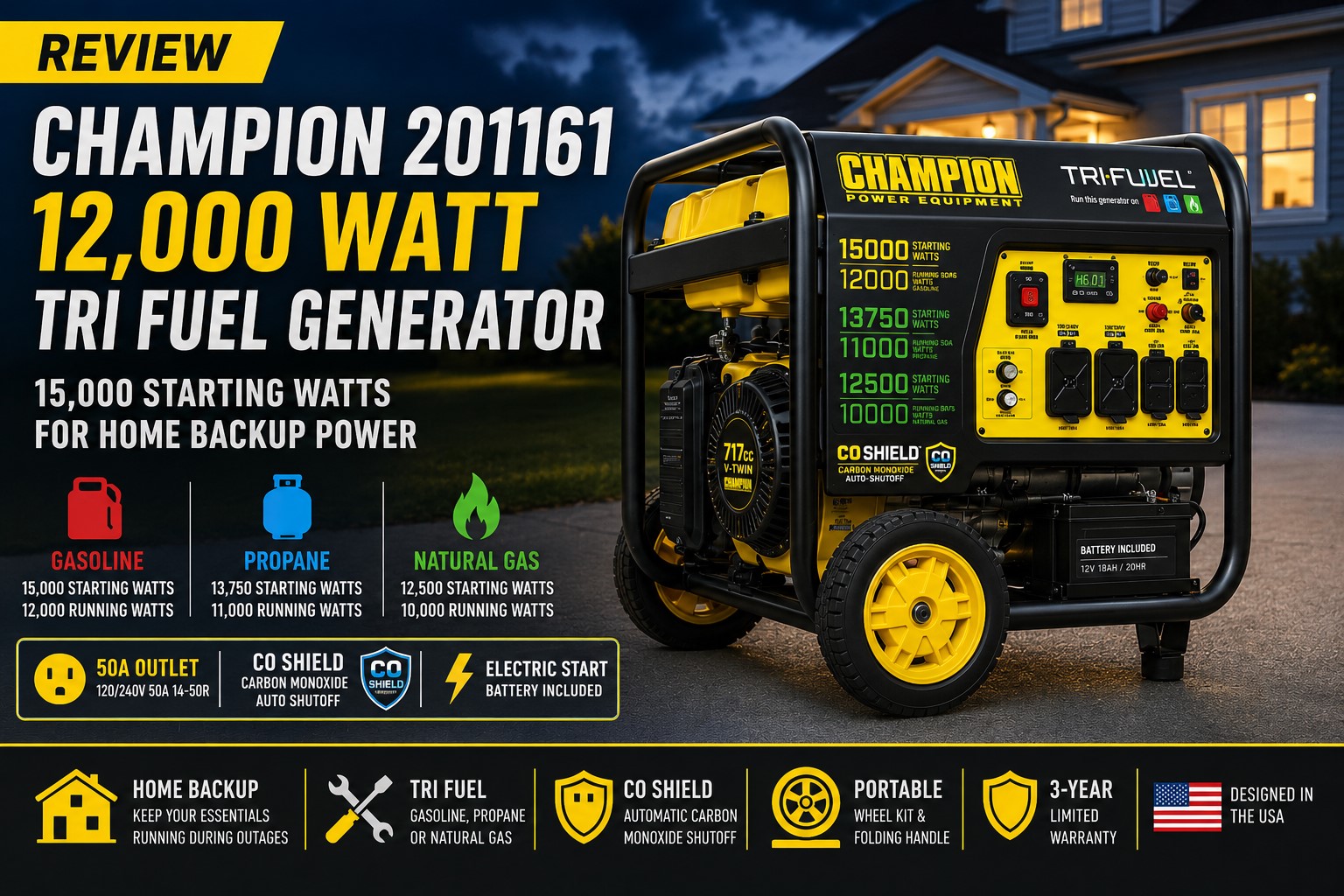
Is the Champion 201161 a good 12,000 watt tri fuel generator?
Yes. The Champion 201161 is one of the stronger portable home-backup generators for buyers who want fuel flexibility. It is marketed around 15,000 starting watts, but for real-world planning, the key number is 12,000 running watts on gasoline. That running-watt rating is what helps determine what the generator can continuously power during an outage.
Why this generator stands out
Most portable generators run on gasoline. Some add propane. The Champion 201161 goes further by supporting natural gas, propane, and gasoline out of the box. That matters during long outages because gasoline can be hard to store, propane runtime depends on tank size, and natural gas can be convenient when your home has a properly installed gas connection.
Champion 201161 key specifications
| Model | Champion Power Equipment 201161 |
|---|---|
| Generator type | Portable tri-fuel generator |
| Fuel options | Gasoline, propane, and natural gas |
| Gasoline output | 15,000 starting watts / 12,000 running watts |
| Propane output | 13,750 starting watts / 11,000 running watts |
| Natural gas output | 12,500 starting watts / 10,000 running watts |
| Engine | 717cc Milwaukee Series V-Twin engine |
| Start type | Battery-included electric start |
| Gasoline runtime | Up to 9 hours at 50% load on an 11-gallon tank |
| Propane runtime | Up to 3.5 hours at 50% load on a 20-pound propane tank |
| Noise rating | 78 dBA from 23 feet |
| Major outlets | 120/240V 50A 14-50R, 120/240V 30A L14-30R, 120V 30A L5-30R, and two 120V 20A GFCI household duplex outlets |
| Included hoses | Natural gas hose kit and propane hose with regulator |
| Safety feature | CO Shield carbon monoxide auto shutoff |
| Warranty | 3-year limited warranty with lifetime technical support |
Gasoline vs propane vs natural gas output
Tri-fuel generators do not usually produce the same wattage on every fuel. Gasoline gives this model its highest output, propane is slightly lower, and natural gas is lower again. That is normal, but it matters when sizing a generator for a home.
Gasoline
15,000 starting watts
12,000 running watts
Best when you need the most power, but requires fuel storage and refueling.
Propane
13,750 starting watts
11,000 running watts
Good backup fuel option, but runtime depends heavily on tank size.
Natural gas
12,500 starting watts
10,000 running watts
Great for home backup convenience when a proper gas connection is available.
Can a 12,000 watt tri fuel generator power a house?
A 12,000 running watt generator can power many important home circuits, but it should not be treated like an unlimited whole-house standby system. With the right transfer switch or generator inlet setup, this size can often support essentials such as refrigerators, lights, sump pumps, furnace blowers, well pumps, internet equipment, TVs, and selected larger appliances depending on starting watt requirements.
- Emergency home backup
- Refrigerator and freezer power
- Sump pump or well pump support
- Gas furnace blower
- Lights, fans, internet, and TVs
- Selected 240V loads with proper wiring
- Jobsites and heavy tools
- Central air conditioning
- Electric water heaters
- Electric dryers
- Large electric ranges
- Multiple high-draw appliances at once
- Hard-starting motors and pumps
- Whole-house loads without load management
Why the 50 amp outlet matters
The 120/240V 50A 14-50R outlet is one of the biggest reasons this generator is worth targeting as a 50 amp tri fuel generator. A 50A outlet gives you more connection flexibility than smaller 30A-only portable generators, especially when using a compatible generator inlet and transfer setup.
Pros and cons
Pros
- Runs on gasoline, propane, or natural gas.
- Strong 12,000 running watt output on gasoline.
- Includes natural gas and propane hoses.
- 50A 14-50R outlet for larger home-backup setups.
- Electric start with included battery.
- CO Shield carbon monoxide auto shutoff.
- 717cc V-Twin engine for heavy-duty output.
- Wheel kit and foldaway handle for movement.
- 3-year limited warranty.
Cons
- Large and heavy at more than 300 pounds.
- Not as quiet as inverter generators.
- Natural gas output is lower than gasoline output.
- Propane runtime on a 20-pound tank is limited.
- Requires safe outdoor operation because it produces carbon monoxide.
- Home connection requires proper electrical installation.
- More generator than many small homes or campers need.
Champion 201161 vs standby generator
The Champion 201161 is a portable generator, not a permanently installed standby generator. That means it usually costs less than a full standby system and gives you fuel flexibility, but it also requires setup, outdoor placement, cable connection, and manual operation during an outage.
- Lower upfront cost than many standby systems
- Natural gas, propane, and gasoline flexibility
- Portable power for home and jobsite use
- 50A output for larger backup needs
- A generator you can store when not in use
- Automatic startup during outages
- Permanent installation
- Less manual setup
- Whole-house backup with automatic transfer
- A system sized by a licensed installer
Who should buy the Champion 201161?
The Champion 201161 is best for homeowners who want a powerful portable generator for backup power and do not want to rely on just one fuel source. It is especially appealing if your home has natural gas available and you want the option to use gasoline or propane when needed.
Consider this model if you want:
- A 12,000 watt tri fuel generator for home backup
- A portable generator with natural gas hookup
- A 50 amp tri fuel generator with 120/240V output
- Electric start and CO safety shutoff
- A large generator for outages, storms, and emergency prep
Safety notes before using this generator
This generator must be operated outdoors only, far away from windows, doors, garages, crawlspaces, and vents. CO Shield is a helpful safety feature, but it is not a replacement for safe placement or working carbon monoxide alarms inside your home.
- Never run a generator indoors or in a garage.
- Point exhaust away from people and buildings.
- Use heavy-duty outdoor-rated cords when needed.
- Use a transfer switch or interlock for home circuits.
- Let the generator cool before refueling.
- Install carbon monoxide alarms inside your home.
Frequently asked questions
Is the Champion 201161 really a 15,000 watt generator?
Yes, but 15,000 watts refers to starting watts on gasoline. The more important number for continuous use is 12,000 running watts on gasoline.
Does the Champion 201161 run on natural gas?
Yes. The Champion 201161 is a tri-fuel generator that can run on natural gas, propane, or gasoline. It also includes a natural gas hose kit.
How many watts does it produce on natural gas?
On natural gas, it produces 12,500 starting watts and 10,000 running watts.
How many watts does it produce on propane?
On propane, it produces 13,750 starting watts and 11,000 running watts.
Does it have a 50 amp outlet?
Yes. It includes a 120/240V 50A 14-50R outlet, plus 30A locking outlets and 120V household outlets.
Can this generator power a whole house?
It can power many important home circuits when properly connected, but whether it can power your whole house depends on your appliances, starting watts, fuel type, and load management.
Is a tri fuel generator better than dual fuel?
A tri-fuel generator gives you more fuel flexibility because it can run on gasoline, propane, or natural gas. A dual-fuel generator usually runs on only gasoline and propane.
Is this generator quiet?
It is rated at 78 dBA from 23 feet, so it is not a quiet inverter generator. It is built more for high-output backup power than low-noise camping.
Does CO Shield make it safe to use indoors?
No. CO Shield is an added safety feature, but this generator must still be used outdoors only, far away from windows, doors, vents, and occupied spaces.
Check current Champion 201161 offers
If you need a 12,000 watt tri fuel generator with natural gas hookup, propane capability, gasoline power, electric start, CO Shield, and a 50 amp outlet, the Champion 201161 is one of the strongest portable home-backup options to compare.
As an affiliate site, we may earn from qualifying purchases. Product pricing and availability are subject to change.