Power Tools Generator Size Calculator
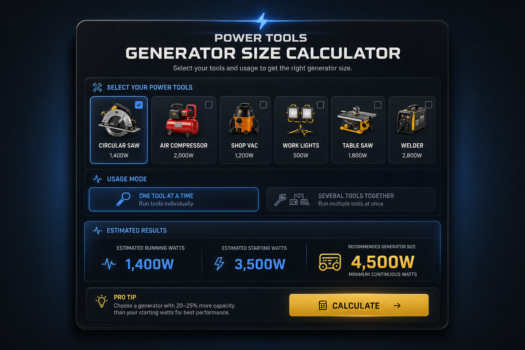
Select your tools and estimate what size generator may fit your garage, jobsite, or DIY power needs.
Power tools can use more electricity than many people expect, especially when motors start, blades bind, compressors kick on, or several tools are used during the same work session. A generator that seems large enough on paper may still struggle if the starting watts are too high or if too many tools are connected at once.
The Power Tools Generator Size Calculator helps you estimate what size generator may fit your garage, workshop, jobsite, or DIY power needs. Select the tools you plan to use, choose whether you will run one main tool at a time or several tools together, and the calculator will estimate your running watts, starting watts, and recommended generator size range.
How This Power Tools Generator Calculator Works
This calculator uses common wattage estimates for tools such as circular saws, miter saws, table saws, air compressors, shop vacs, work lights, battery chargers, angle grinders, pressure washers, welders, and sanders.
After you select your tools, the calculator estimates two important numbers: running watts and starting watts. Running watts are what your tools may use once they are operating. Starting watts include the extra power some tools need when the motor first starts or when the tool is under heavier load.
This matters because a saw, compressor, pressure washer, or shop vac may pull more power for a short period than the basic running watt number suggests.
One Tool at a Time vs. Several Tools Together
Not everyone uses tools the same way. A homeowner doing weekend projects may only run one main tool at a time, while a jobsite setup may need lights, chargers, a shop vac, and a saw available during the same work session.
That is why this tool includes a usage choice. If you choose one main tool at a time, the estimate is more realistic for many garage and DIY users. If you choose several tools together, the estimate becomes more conservative because it assumes more equipment may be running during the same period.
This helps keep the result useful without forcing every visitor into an oversized recommendation.
Why Starting Watts Matter for Power Tools
Power tools with motors can behave differently than small electronics. A battery charger or work light may have steady power needs, but a saw, grinder, compressor, pump, or pressure washer can create higher demand at startup or under load.
Air compressors are especially important to watch because the motor may cycle on while other tools are already being used. Welders can also require careful matching because their power needs vary by model, output setting, and duty cycle.
The safest approach is to start the largest or highest-surge tool first, let it stabilize, then add smaller tools, chargers, or work lights.
What Size Generator Do You Need for Power Tools?
The right generator size depends on the tools you plan to run and how you use them. A smaller generator may be enough for work lights, battery chargers, a sander, and light-duty tools. A mid-size generator may be better for saws, shop vacs, grinders, and occasional compressor use. Larger jobsite setups may need more power, especially if a welder, large compressor, pressure washer, or multiple tools are part of the plan.
For many DIY and garage users, the right generator may fall somewhere in the 3,500 to 6,500 watt range. Heavier tool setups may push into the 7,500 to 12,000 watt range or higher.
Use the calculator result as a starting point before comparing generator models.
Extension Cords and Safe Tool Use
Generator size is only part of the setup. Extension cords also matter. A cord that is too long or too light for the load can reduce performance and create safety problems.
Always use outdoor-rated extension cords that match the tool’s wattage and distance from the generator. For higher-demand tools, check the cord gauge carefully and avoid running several heavy tools through one undersized cord.
If you are using a generator at a jobsite, also consider grounding requirements, weather protection, fuel safety, and proper placement away from doors, windows, and enclosed spaces.
Use the Results Before You Buy
Once you get your estimate, compare the recommended generator range with the generators you are considering. If your result is close to the top of a generator’s capacity, moving one size up may give you more breathing room.
That extra room can matter when a compressor kicks on, a saw binds, a shop vac starts, or multiple tools are used during the same project. The goal is not just to buy a generator that barely works. The goal is to choose one that can support your tools without constant overload worries.
Important Safety Note
This calculator provides general estimates only. Actual wattage can vary by tool brand, motor size, age, startup surge, load, duty cycle, cord length, cord gauge, and how many tools are running at once.
Always check your tool labels, generator manual, extension cord ratings, and safe connection requirements before using a generator. For larger equipment, welders, or jobsite power setups, consider speaking with a qualified electrician or equipment professional.
FAQ: Frequently Asked Questions
What size generator do I need for power tools?
The right generator size depends on the tools you want to use and whether you run one main tool at a time or several tools together. Light-duty tools, chargers, and work lights may need less power, while saws, compressors, pressure washers, and welders usually require a larger generator.
Why do power tools need starting watts?
Many power tools use motors. When those motors first start, or when the tool is under load, they may need more power for a short moment. This is why starting watts matter for tools like circular saws, table saws, shop vacs, pressure washers, and air compressors.
Can a small generator run power tools?
A small generator may run light-duty tools, battery chargers, work lights, sanders, and some smaller saws. However, it may struggle with air compressors, welders, pressure washers, table saws, or multiple tools running at the same time.
Should I choose one tool at a time or several tools together?
Choose one tool at a time if you usually run one main tool while keeping only small items like chargers or lights connected. Choose several tools together if you expect to use multiple tools, shop vacs, chargers, compressors, or lights during the same work session.
Why do extension cords matter with generators and power tools?
Extension cords matter because long or undersized cords can reduce performance and create safety risks. Always use outdoor-rated cords with the correct gauge for the tool, wattage, distance, and generator setup.