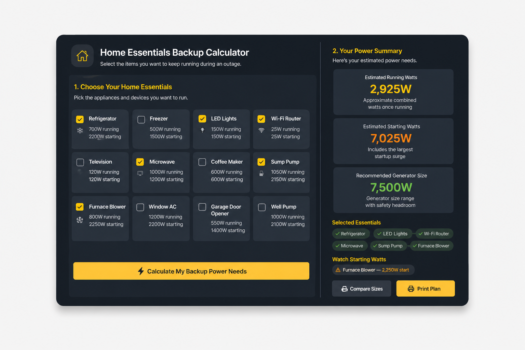
Home Essentials Backup Calculator
Select the items you want to keep running during an outage and estimate what size generator you may need.
Choose Your Home Essentials
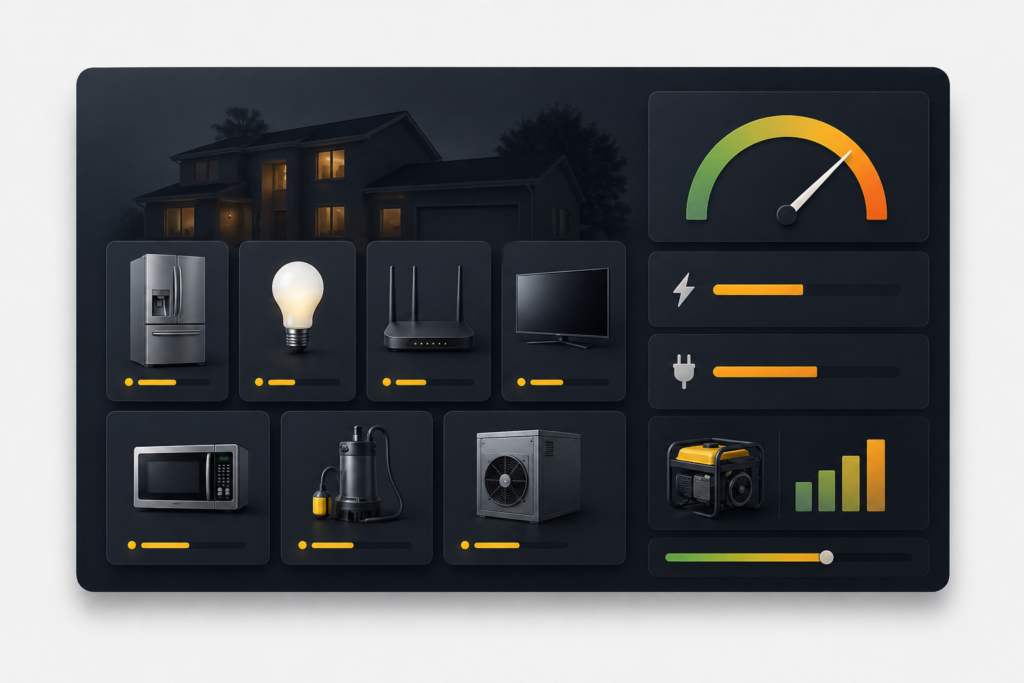
Pick the appliances and devices you want to run. The calculator will estimate running watts, starting watts, and a recommended generator range.
Power outages have a way of showing you what really matters at home. The refrigerator needs to stay cold, the lights need to work, the Wi-Fi may need to stay on, and certain homes may also need a sump pump, furnace blower, CPAP machine, or well pump.
The Home Essentials Backup Calculator helps you estimate what size generator you may need based on the items you actually want to keep running during an outage. Instead of guessing by wattage alone, you can select your home essentials and get a practical estimate for running watts, starting watts, and a recommended generator size range.
How This Home Backup Calculator Works
This calculator lets you choose common household items such as a refrigerator, freezer, LED lights, Wi-Fi router, television, microwave, coffee maker, CPAP machine, sump pump, furnace blower, window air conditioner, well pump, washing machine, and garage door opener.
After you select your items, the tool estimates two important numbers: running watts and starting watts. Running watts are the power your selected items may use once they are already operating. Starting watts include the extra surge some appliances need when they first turn on.
That extra startup demand is why a generator that looks large enough on paper may still struggle when a refrigerator, pump, blower, or air conditioner starts at the wrong time.
Why Starting Watts Matter During an Outage
Many home essentials do not use the same amount of power all the time. A refrigerator may run at one wattage after it starts, but it can need more power for a few seconds when the compressor kicks on. The same idea applies to sump pumps, well pumps, furnace blowers, washing machines, and window air conditioners.
This is why the calculator does more than add up basic appliance numbers. It also gives you a safer estimate that accounts for the largest likely starting surge. That helps you avoid choosing a generator that is too small for real outage conditions.
What Size Generator Do You Need for Home Essentials?
The right size depends on what you want to keep running. A smaller generator may be enough for lights, phone charging, a router, a TV, and maybe a refrigerator. A larger generator may be needed if you want to add a freezer, sump pump, furnace blower, microwave, window AC, or well pump.
For many homes, a generator in the 5,500 to 7,500 watt range can cover several common essentials, but every setup is different. Homes with well pumps, electric heat, central air conditioning, electric water heaters, or several high-demand appliances may need a much larger setup.
This calculator gives you a helpful starting point so you can compare generator sizes before reading reviews or visiting product pages.
Use the Results Before You Buy
Once you get your estimate, compare the recommended range with the generators you are considering. If your selected items put you close to the limit, moving one size up may give you more breathing room.
That extra room can matter during a real outage. You may decide to plug in an extra appliance, run a microwave briefly, or keep another room lit. A generator that is constantly pushed near its limit may be less convenient and more stressful to manage.
The goal is not to run every appliance in your home at once. The goal is to understand which essentials matter most and choose a generator that can handle them safely and realistically.
Important Safety Reminder
This calculator provides general estimates only. Appliance wattage can vary by brand, model, age, startup surge, and how the item is used. Always check the appliance label, generator manual, manufacturer documentation, and safe connection requirements before using a generator.
For home backup setups that involve a transfer switch, standby generator, hardwired connection, or larger household loads, speak with a qualified electrician or licensed installer. Never run a generator indoors, in a garage, or near windows, doors, or vents.
FAQ: Frequently Asked Questions
What size generator do I need for home essentials?
The right size depends on which appliances and devices you want to run. Basic essentials such as lights, a Wi-Fi router, phone charging, and a refrigerator may need less power than a setup that includes a sump pump, furnace blower, well pump, microwave, or window air conditioner.
What is the difference between running watts and starting watts?
Running watts are the watts an appliance uses once it is operating. Starting watts are the extra watts some appliances need for a short moment when they first turn on. Items with motors or compressors, such as refrigerators, pumps, furnace blowers, and air conditioners, often have higher starting watts.
Can a portable generator power my whole house?
Most portable generators are better for selected essentials, not every appliance in the home at once. Larger portable generators may support more circuits, but central air conditioning, electric dryers, electric water heaters, electric ranges, and well pumps can require careful load planning.
Why does the calculator include starting watts?
Starting watts help give a more realistic estimate during an outage. If several appliances are running and a pump, refrigerator, or air conditioner starts, the generator may need extra surge power for a few seconds. That is why the calculator looks beyond running watts alone.
Should I choose a generator larger than my estimate?
In many cases, choosing one size above your estimated need can give you more breathing room. This may help if you add another appliance, run a microwave briefly, or want to avoid pushing the generator close to its limit.