What Can a 17,000-Watt (17 kW) Generator Actually Power?
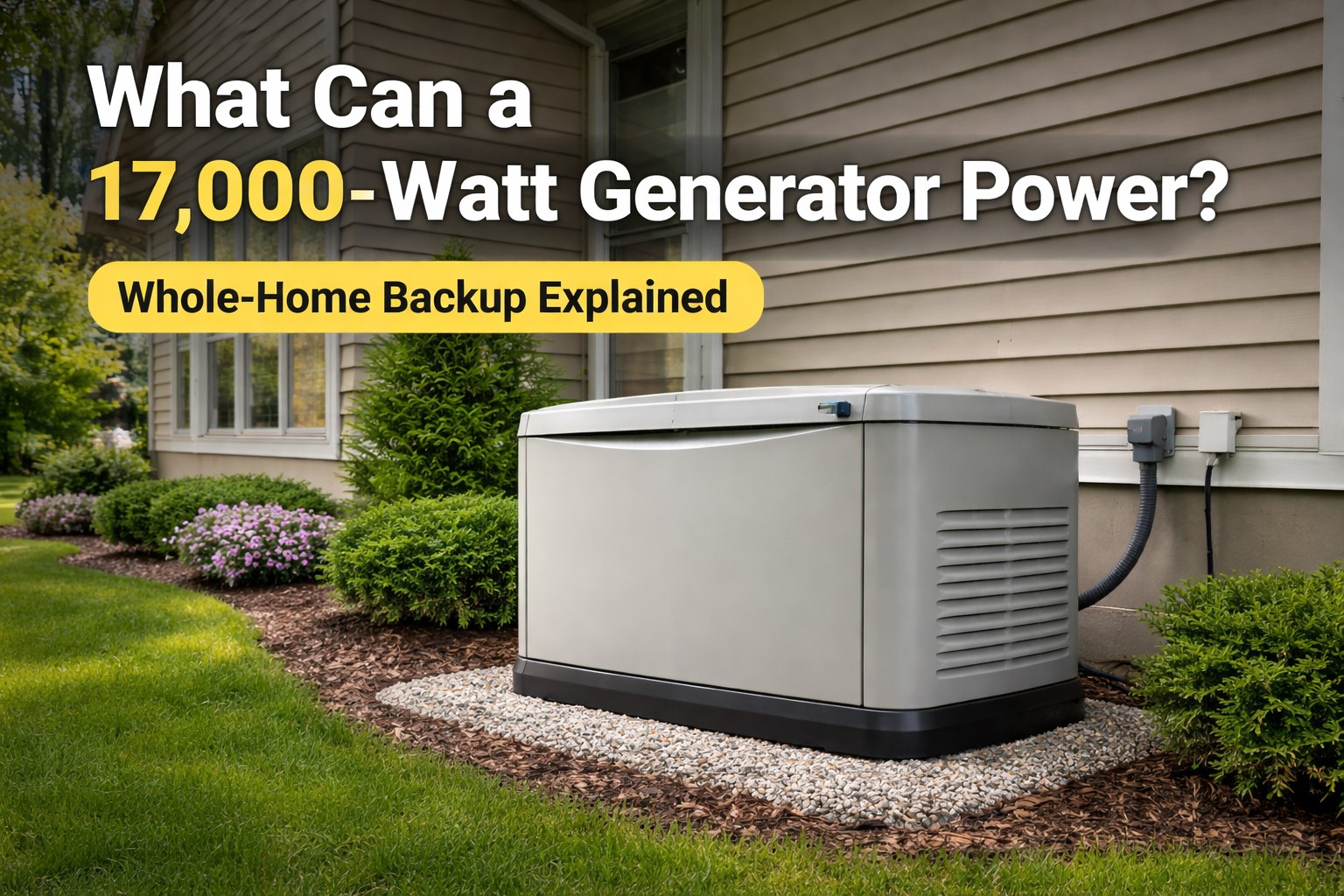
A 17,000-watt generator — also labeled as 17 kW — is considered a high-capacity residential generator. This size is commonly used for whole-home backup systems and can power most or all essential household systems during an outage.
But whether it runs everything depends on your home’s electrical load.
Let’s break it down clearly.
Understanding What 17,000 Watts Really Means
One kilowatt equals 1,000 watts. So a 17 kW generator produces 17,000 watts of power.
That amount of output is typically enough to support:
• Major appliances
• Heating and cooling systems
• Lighting circuits
• Kitchen equipment
• Well pumps or sump pumps
• Electronics and home office setups
The key factor is not just total wattage, but how much power starts at once.
Typical Appliances a 17,000-Watt Generator Can Run
Here’s a realistic look at common household loads:
| Appliance | Running Watts | Starting Watts |
|---|---|---|
| Central Air Conditioner (3–4 ton) | 3,500–5,000 | 6,000–9,000 |
| Electric Water Heater | 4,500 | 4,500 |
| Refrigerator | 600–800 | 1,200–2,000 |
| Microwave | 1,000–1,500 | 1,500 |
| Electric Range (1 burner) | 1,500–2,000 | 2,000 |
| Well Pump (1 HP) | 1,500 | 3,000 |
| Lights & Electronics (whole house) | 1,000–2,000 | — |
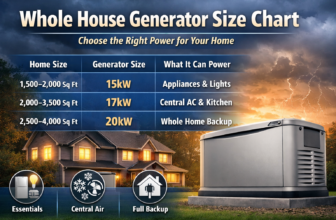
A 17,000-watt generator can handle multiple large loads at once — including central air — which is why it’s often installed as a standby generator for homes between 2,000 and 3,500 square feet.
Can a 17 kW Generator Run an Entire House?
In many cases, yes.
If your home uses:
• Gas heating
• Gas stove
• Gas water heater
Then a 17 kW generator can usually power the entire house comfortably.
If your home is fully electric — especially with electric heat and large HVAC systems — you may need 20–24 kW for full coverage.
That’s why load calculation matters.
Running Watts vs Starting Watts — Why It Matters
Many appliances require extra power for a few seconds when they start.
For example:
A central AC unit may run at 4,000 watts but briefly spike to 8,000+ watts when starting.
If too many high-start appliances kick on simultaneously, the generator can overload.
Most modern standby generators manage this using load-shedding systems that prioritize critical circuits.
When a 17,000-Watt Generator Is the Right Choice
This size is ideal if:
• You want whole-house backup (not just essentials)
• You have central air conditioning
• You live in hurricane or storm-prone areas
• You rely on a well pump
• You work from home and need uninterrupted power
It’s also a popular size for small businesses or large job sites.
When It Might Be Too Much (Or Not Enough)
Too much if:
• You only need refrigerator + lights + small electronics
• You’re powering a small cabin
Not enough if:
• You have multiple HVAC systems
• Your home exceeds 4,000 square feet
• You use electric heat
• You plan to run everything simultaneously
Portable vs Standby 17 kW Generators
Most 17 kW units are:
• Permanently installed standby generators
• Powered by natural gas or propane
• Connected through a transfer switch
Portable generators rarely reach 17,000 running watts — and if they do, they are large, heavy, and industrial-grade.
17 kW vs Other Popular Generator Sizes
Choosing the right generator size depends on how much of your home you want to power.
Here’s how 17 kW compares to other common options:
🔹 12,000–13,000 Watts (12–13 kW)
Best for:
- Essentials only
- Refrigerator
- Lights
- Small appliances
- Possibly one smaller AC unit
Limitations:
- May struggle with electric water heaters
- Limited whole-home capacity
Good option for budget-conscious buyers who don’t need full backup.
🔹 17,000 Watts (17 kW)
Best for:
- Central air conditioning
- Electric water heater
- Well pump
- Kitchen appliances
- Full lighting circuits
- Home office setup
Ideal for:
- 2,000–3,500 sq ft homes
- Storm-prone regions
- Homeowners wanting minimal compromise during outages
This is the “balanced whole-house” size.
🔹 20,000–24,000 Watts (20–24 kW)
Best for:
- Large homes over 3,500 sq ft
- Multiple HVAC systems
- Fully electric homes
- High-demand usage
More expensive upfront but allows true full-capacity backup.
Should You Choose 17 kW?
If you want central AC, water heating, refrigeration, and lighting running simultaneously during an outage without carefully managing loads, 17 kW is often the sweet spot.
For most medium-to-large homes, it provides strong whole-home coverage without jumping into higher price brackets.
👉 If you’re comparing real models, see our detailed guide:
Best 17,000-Watt Generators for Whole House Backup
Final Answer: What Does a 17,000-Watt Generator Power?
In practical terms, a 17,000-watt (17 kW) generator can power:
• Central air conditioning
• Refrigerator and freezer
• Water heater
• Kitchen appliances
• Well pump
• Lights and outlets
• Internet and office equipment
For many homes, that equals full operational capacity during an outage.
The exact answer depends on your electrical panel and total load, but this size is generally considered whole-home capable for medium to large houses.
FAQ Section
Is 17,000 watts enough to run central air?
Yes. A 17 kW generator can typically handle a 3–4 ton central AC system, including starting watt requirements.
Can a 17 kW generator run two air conditioners?
Possibly, but it depends on their size and starting surge. Load management may be required.
Is 17 kW considered a whole house generator?
Yes. For many average-size homes, 17 kW is marketed and installed as a whole-house standby generator.
What size breaker panel does a 17 kW generator need?
It usually connects to a 200-amp service panel using an automatic transfer switch.